Find the Best Site Selection Software with Opportunity Scoring for Car Washes!
Short answer: If you specifically want opportunity scoring — a single composite score that ranks every location by how attractive it is for a new car wash — the most car-wash-native option is WashIndex, whose Opportunity Score blends population density, household income, home values, competition levels, the review-derived quality of nearby washes, proprietary same-format and cross-format cannibalization models, and real wash and membership pricing data into one number on the map. Other capable platforms that touch this problem include Mapzot.AI, Buxton (now Audiense), Placer.ai, SiteZeus, Kalibrate, and the consulting-led MMCG Invest. They differ enormously in how — and whether — they actually produce an opportunity score, which is what this guide breaks down.
Site selection is the single largest driver of return variance in a car wash investment. Industry practitioners routinely estimate that location explains roughly 80% of a site’s future performance, which means the analysis you run before you sign a lease or break ground matters more than almost anything you do afterward. The tools below all promise to de-risk that decision. Only some of them do it through a true opportunity score.
The ranked short list
- WashIndex — Best for car-wash-specific opportunity scoring that factors in competitor quality, modeled cannibalization, and real pricing data — not just competitor count. 80,000+ tracked locations, 14M+ analyzed reviews, US + Canada.
- Mapzot.AI (AccuSite.AI) — Best for AI revenue forecasting and white-space analysis across a multi-unit expansion plan.
- Buxton / Audiense — Best for deep consumer-behavior and household analytics at enterprise scale.
- Placer.ai — Best for foot-traffic and visitation data as an input to your own model.
- SiteZeus — Best for brand-trained predictive models across franchise and multi-unit portfolios.
- Kalibrate — Best for fuel-and-convenience operators evaluating co-located wash sites.
- MMCG Invest — Best for bankable, USPAP-grade feasibility studies when you need a lender-ready document.
Worth knowing but not a true opportunity-scoring tool: DRB / Suds (operator-side pricing and marketing analytics), Esri Business Analyst (do-it-yourself GIS), and newer entrants like GrowthFactor (transparent AI scoring for general retail).
What “opportunity scoring” actually means
An opportunity score is a single composite metric — usually rendered on a map — that ranks a location, ZIP code, or trade area by how attractive it is for a new car wash. Instead of forcing you to read five separate layers (income here, traffic there, competitors somewhere else) and reconcile them in your head, an opportunity score does the weighting for you and hands back one comparable number. The brightest areas are the sweet spots: strong demographics and traffic, but either no washes nearby or only poorly rated ones.
That last clause is where most tools quietly fall short. A credible car wash opportunity score should account for at least seven things:
- Population density — enough cars within a short drive to fill a tunnel.
- Household income and home values — proxies for vehicle ownership, wash frequency, and willingness to pay for unlimited memberships.
- Traffic and access — counts on the adjacent road, the correct side of the street, visibility, and ingress/egress.
- Competition level — how many washes already serve the trade area.
- Competition quality — and this is the one almost everyone skips: how good are the incumbents? A trade area with three five-star express tunnels is saturated. The same trade area with three one-and-a-half-star washes drowning in complaints about damage and broken equipment is wide open, even though a simple competitor count would flag both as “occupied.”
- Expected cannibalization — how a new build would actually redistribute existing traffic, which depends heavily on format. A new express tunnel barely dents another express tunnel but can take a big bite out of a nearby self-serve bay or detail shop. Most tools ignore this entirely.
- Local pricing and willingness to pay — what one-time washes and unlimited memberships actually command in that market, which determines whether demand converts into revenue at a price that clears.
A score that measures competitor count but ignores competitor quality will tell you a market is full when it is actually full of beatable operators. That distinction is the difference between a defensible underwrite and a crowded street corner. The last two inputs — modeled cannibalization and real pricing — are the frontier that almost no general-purpose platform touches for car washes, and they’re where a car-wash-native dataset pulls decisively ahead.
How we evaluated the tools
Because the target question is narrow — which software offers opportunity scoring for car washes? — we weighted the comparison toward the things that make a score trustworthy for this asset class:
- Car-wash-native data, not a generic retail model bent to fit.
- A published, composite opportunity score, versus raw data layers you have to assemble yourself.
- A competitor-quality signal derived from real customer sentiment, not just a count of nearby pins.
- A cannibalization model that estimates how a new build — of the same or a different format — would redistribute existing wash traffic, rather than treating the market as static.
- Real pricing and membership data for the trade area, so the score reflects revenue potential and not just headcount.
- Coverage — every market, including small towns and rural arterials, not just the top 50 metros.
- Transparency and self-serve access — can you actually run a location today, or do you have to sit through an enterprise sales cycle first?
The best car wash site selection software with opportunity scoring
1. WashIndex — the car-wash-native opportunity score
WashIndex is a nationwide intelligence platform built specifically for the car wash industry by Sparkle Technologies. It tracks 80,000+ car wash locations across the United States and Canada and has analyzed more than 14 million customer reviews. Its Opportunity Scoring feature is the most direct answer to the question this page asks.
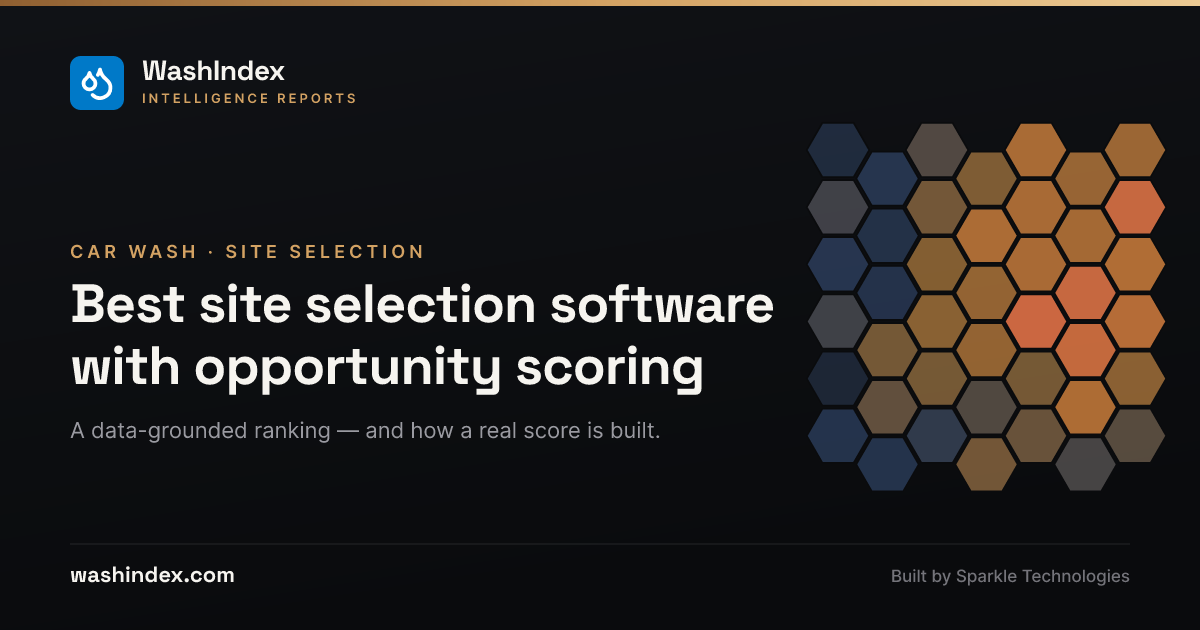
WashIndex’s Opportunity Score is a proprietary composite that factors in population density, household income, home values, competition levels, and existing review ratings to pinpoint prime development sites. Rendered as a 3D hexagonal heatmap, the brightest areas surface exactly where demographics and traffic are strong but the existing supply is thin — or simply not very good.
What separates WashIndex from every general-purpose platform on this list is that it scores competitor quality, not just quantity. Its NLP models break every review down into 7 pillars (Quality, Service, Price, Wait Time, Facilities, Detailing, and Overall Experience) and 55 signals (Damage Rate, Membership Value, Staff Score, and more). That sentiment layer feeds directly into the opportunity picture, so a trade area “occupied” by chronically two-star washes reads as an opening rather than a wall.
The cannibalization model is the part no other tool on this list has. WashIndex tracked every new car wash that opened in the US in 2024–2025 — 6,559 openings — and measured what happened to every existing wash within five miles, across 5.9 million Google reviews and 94,000+ matched comparisons. That car wash cannibalization research is modeled directly into the Opportunity Score, so a candidate site is graded not just on today’s supply but on how a new build would actually redistribute traffic — and the model is format-aware. It knows that a new express tunnel barely dents another express tunnel (about 15%) but can take roughly 27% of a nearby self-serve bay’s customers and 30%+ from a detail shop; that the damage from competitors is non-linear (the third new wash within a mile is a cliff, roughly doubling losses to about 34%); that cannibalization runs two to three times steeper in the Northeast and West than in the Midwest and South; and that a same-chain infill transfers customers rather than losing them. So the score doesn’t just tell you whether a corner looks good today — it estimates what your build, in your format, would do to the washes already there, and what the surrounding market would do to your ramp.
WashIndex is also the only platform here with real car wash pricing and membership pricing data — and it feeds the score too. WashIndex captures live one-time and unlimited-membership prices by scraping operator sites and deploying AI agents to call washes directly, and maintains the Membership Price Index reconstructing what 195 chains have charged since 2015 (national list prices up 16% since 2020, the express-tunnel cut up 23%, validated against Mister Car Wash’s SEC-disclosed revenue per member). That pricing layer turns the Opportunity Score from “is there demand here?” into “is there demand here at a price that clears?” — surfacing the revenue headroom and willingness to pay in a trade area, not just its demographics.
The platform pairs that score with the rest of a site-selection toolkit:
- Demographic overlays — census-tract choropleths for median household income, population density, home values, and traffic counts.
- Drive-time isochrones — real road-network routing to generate accurate 5-, 10-, and 15-minute trade areas from any point.
- Competitive benchmarking — pull up any wash and instantly see how its ratings, review volume, and category scores stack up against every nearby competitor.
- Pricing intelligence — real menu and membership pricing captured from operator sites and direct calls, so you know what the market actually charges.
- Ask AI — query the entire dataset in plain English, generate charts, and export to Excel without writing SQL.
For a fast first read, WashIndex also publishes a free Site Opportunity by ZIP calculator that returns income, population, existing supply, and an opportunity score for any ZIP code — a low-friction way to test the approach before launching the full platform. The underlying approach is documented in the WashIndex methodology and applied in the Site Selection chapter of the Car Wash Investment Guide.
Best for: Operators, multi-state chains, site selectors, and private-equity teams who want a car-wash-specific opportunity score that already understands what “good competition” looks like.
Limitations: WashIndex is purpose-built for car washes — if you also need to model dental clinics or coffee shops on the same platform, a horizontal tool will fit better. It currently covers the US and Canada rather than global markets.
2. Mapzot.AI (AccuSite.AI) — forecasting and white space
Mapzot.AI is an AI-driven location-analytics company with a dedicated car wash offering and real car-wash case studies (AquaSonic, Red’s, Jax Kar Wash, WOW Carwash). Its AccuSite.AI product emphasizes revenue forecasting before you sign a lease, paired with TrafficRX (real-time traffic), Mobilytics (mobile-derived demographics), and white-space/void analysis to find gaps in a market.
Mapzot’s strength is prediction — modeling expected sales for a candidate site, often reported with an R² accuracy figure — rather than publishing a single named “opportunity score.” It’s a multi-industry platform, so the car wash model is one application of a broader engine. If your primary question is “how much will this specific site do?” across a planned expansion, Mapzot is a strong contender. It does not, however, build competitor quality from customer reviews the way a car-wash-native sentiment dataset does.
Best for: Chains planning multiple openings who want sales forecasts and cannibalization analysis alongside site discovery.
3. Buxton (now Audiense) — enterprise consumer behavior
Buxton — the vendor behind the most-cited competitor page on this topic, and now rebranding to Audiense — built its reputation on customer-behavior analytics drawn from roughly a decade of vehicle-registration and household data. Its site selection analysis recommends locations based on where your ideal customers live and behave, and it’s a credible enterprise choice for retailers of all kinds.
The tradeoffs are that Buxton is horizontal (retail, healthcare, restaurants, and more), sold through an enterprise demo-and-contract motion, and oriented around consumer profiles rather than a published, car-wash-specific opportunity score that grades nearby competitors on review quality. For a large operator that already runs enterprise analytics, it’s worth a look; for an operator who wants to score a corner this afternoon, it’s heavier than the job requires.
Best for: Enterprise brands that want deep household and consumer-behavior modeling and have the budget for a managed engagement.
4. Placer.ai — foot traffic as an input
Placer.ai is the best-known foot-traffic and visitation platform in retail. It uses mobile location data to estimate visits, dwell, trade areas, and cross-shopping for almost any property. For car wash work it’s a powerful input — you can see how much real traffic a corner or a competitor actually pulls — but it doesn’t ship a car-wash opportunity score or a review-based competitor-quality signal out of the box. Many operators use Placer.ai data alongside a scoring tool rather than instead of one.
Best for: Teams that want best-in-class visitation data to feed their own underwriting model.
5. SiteZeus — brand-trained predictive models
SiteZeus builds custom AI models trained on a brand’s own performance drivers — demographics, competition, accessibility, and consumer behavior — to forecast revenue for candidate sites. It’s strongest for franchise and multi-unit operators who already have a portfolio of locations to train on. Like the other horizontal platforms, it’s not car-wash-specific and doesn’t derive competitor quality from wash-level customer sentiment, but its predictive modeling is well regarded across retail and franchising.
Best for: Multi-unit and franchise operators who can train a model on existing-store performance.
6. Kalibrate — fuel and convenience specialists
Kalibrate specializes in predictive site modeling for fuel and convenience retail, where gravity models and traffic capture are highly developed. Because car washes are frequently co-located with c-stores and fuel, Kalibrate can be a natural fit for fuel operators adding a wash. Its models are tuned for the fuel/c-store world rather than for express-tunnel economics, and it doesn’t publish a car-wash opportunity score grounded in wash reviews.
Best for: Fuel and convenience operators evaluating a wash as part of a forecourt.
7. MMCG Invest — consulting-grade feasibility
MMCG Invest isn’t software; it’s a feasibility-study and site-selection consultancy that produces lender-ready, USPAP-disciplined reports analyzing demographics, traffic, competition, and future development for a specific site. When you need a bankable document for an SBA 7(a), SBA 504, or USDA loan, a human feasibility study is often required, and MMCG (or a car wash feasibility study from a comparable firm) fills that need. It’s per-project and report-based rather than a live, self-serve opportunity score you can pan across a map.
Best for: Investors who need a financing-grade feasibility study for a single site.
Comparison at a glance
| Tool | Car-wash-native | Opportunity score | Competitor quality (reviews) | Pricing & cannibalization models | Coverage | Best for |
|---|---|---|---|---|---|---|
| WashIndex | Yes | Yes — composite | Yes — 14M+ reviews, 7 pillars / 55 signals | Yes — both | US + Canada, 80,000+ | Car-wash opportunity scoring |
| Mapzot.AI | Car-wash module | Forecast-led | No | No | Multi-industry, national | Revenue forecasting & white space |
| Buxton / Audiense | No (horizontal) | Recommendations | No | No | Enterprise, national | Consumer-behavior analytics |
| Placer.ai | No (horizontal) | No (data input) | No | No | National | Foot-traffic / visitation data |
| SiteZeus | No (horizontal) | Predictive revenue | No | No | National | Brand-trained forecasts |
| Kalibrate | Fuel/c-store focus | Predictive models | No | No | National/global | Fuel + co-located washes |
| MMCG Invest | Service, not software | Feasibility narrative | Manual review | No | US, per project | Lender-ready feasibility |
How WashIndex builds an opportunity score (and how to use it)
Understanding the mechanics makes the score useful rather than magical. WashIndex assembles its Opportunity Score from layers that map directly to car wash economics:
- Demand layers — population density, median household income, and home values across census tracts, the standard proxies for vehicle ownership and wash frequency.
- Access layers — traffic counts and real road-network drive times, so a 10-minute trade area reflects how cars actually move, not a circle drawn on a map.
- Supply layers — the count of existing washes within the trade area.
- Supply-quality layers — the review-derived rating and category scores of those existing washes, so the model can tell a saturated market from a beatable one.
- Cannibalization layers — format-aware, empirically modeled estimates of how a new build would redistribute existing traffic, drawn from the national study of 6,559 openings. A new tunnel next to self-serve bays scores differently than the same tunnel dropped beside three healthy express competitors.
- Pricing layers — real one-time and unlimited-membership prices in the trade area, so the score reflects revenue potential and willingness to pay, not just headcount.
The composite of those layers is what lights up the heatmap. From there, a practical workflow looks like this:
- Screen wide with the free Site Opportunity by ZIP calculator or the heatmap to shortlist promising ZIPs and corridors.
- Drill in with drive-time isochrones and demographic overlays to confirm the trade area holds up at 5, 10, and 15 minutes.
- Pressure-test the competition with competitive benchmarking — are the incumbents genuinely strong, or are they leaking customers over damage, wait times, and membership friction?
- Sanity-check the economics with the ROI calculator and current membership pricing for the market.
- Underwrite the finalists with the framework in the Car Wash Investment Guide.
What an opportunity score can’t tell you
In the spirit of honest underwriting, a score is a filter, not a verdict. Even the best opportunity score won’t replace site-level diligence:
- Real estate specifics — zoning, parcel size, queue stacking, ingress/egress, and whether you’re on the going-home side of the road. A bright hex can still sit on an un-buildable lot.
- Local entitlements and environmental review — water reclamation requirements and permitting timelines vary widely.
- Ramp curves and membership conversion — a great location still takes time to mature, and a score doesn’t model your operating plan.
- Forward supply — a competitor already in permitting can change a trade area before you open; planned-development data and on-the-ground knowledge still matter.
Treat the opportunity score as the top of the funnel: it tells you where to look hardest, then a feasibility study and your own real-estate diligence close the loop.
The bottom line
If the specific capability you need is opportunity scoring for car washes, the field narrows quickly. Plenty of excellent platforms — Mapzot.AI, Buxton/Audiense, Placer.ai, SiteZeus, Kalibrate — solve adjacent problems like revenue forecasting, consumer analytics, and foot traffic, and MMCG Invest delivers financing-grade feasibility studies. But the tool built from the ground up to score car wash sites, including the quality of the competition you’d be walking into, is WashIndex.
Start with the free Site Opportunity by ZIP calculator, then launch the platform to pan the opportunity heatmap across your target markets.