Process Problem or Program Problem? Where Car Wash Membership Cancellation Pain Actually Lives
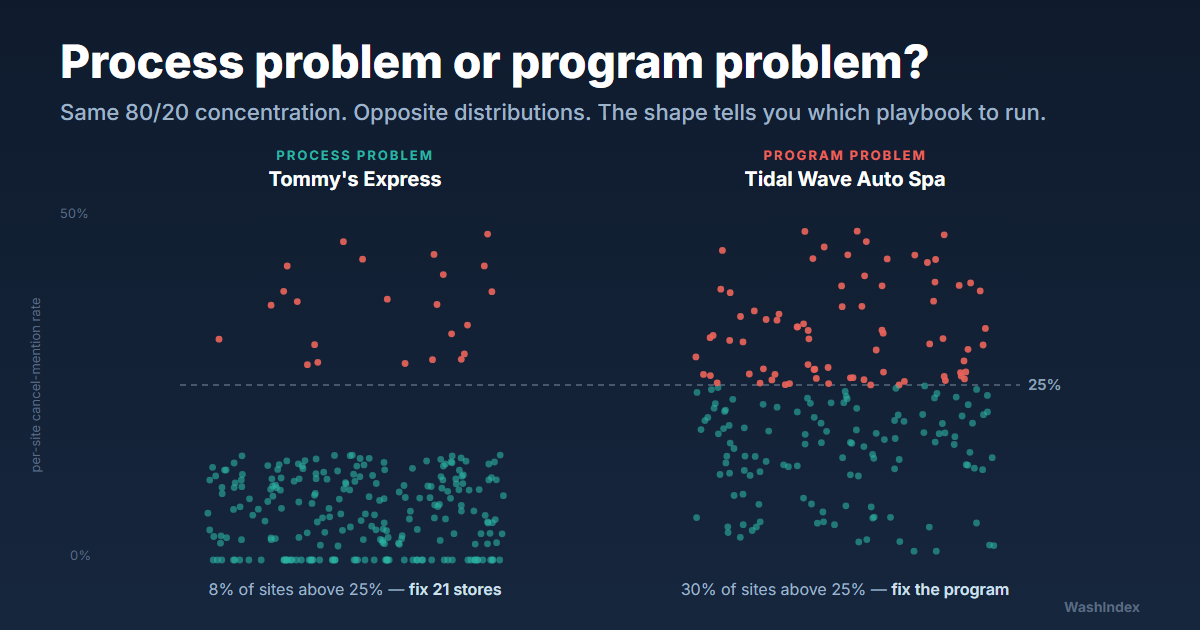
If your membership-pain reviews are concentrated in 2–3 sites, you have a process problem. If they’re spread evenly across the network, you have a program problem. The distinction matters because the playbook is completely different — and most operators don’t have the per-location data to tell which one they’re staring at.
Looking at the four largest express-exterior chains in our dataset, all four show the same headline statistic: the top 10% of sites account for ~30% of cancellation-related review mentions. By that one measure, Tommy’s Express, Tidal Wave, Quick Quack, and Cobblestone all look identically Pareto-distributed.
That’s the trap. The 80/20 concentration is similar across chains. What’s wildly different is the baseline the chain is operating at, and how big the problem tail is. That’s what separates a process problem from a program problem.
The window: this analysis covers Google Maps reviews posted from January 1, 2024 through April 30, 2026 — a deliberately recent window so the picture reflects current operations.
Executive summary
- The diagnosis is not “how concentrated are the complaints” — it’s “what’s the baseline and how big is the tail.” All four chains analyzed have a near-identical ~30% top-decile concentration of cancellation mentions, yet their underlying problems are opposite.
- Process problem = low median cancel-mention rate + a small tail of bad stores. The chain rate is dragged up by a handful of outliers. Fix is operational and site-specific: a targeted intervention list, not a policy overhaul.
- Program problem = elevated median + a broad tail. The typical store is the problem, so the program’s mechanics (cancellation flow, auto-renewal terms, billing-error resolution, perceived value) are what need to change.
- The four diagnoses: Tommy’s Express is a process problem (7.9% median, only 8% of sites above 25%). Tidal Wave is a program problem (20.0% median, 30% of sites above 25%). Quick Quack is the healthy benchmark (just 2 outlier stores in 148). Cobblestone is an extreme program problem (median above the chain rate; 33% of sites above 25%).
- Why it matters: running a chain-wide retention initiative to fix a process problem wastes program-level dollars on a localized supervision gap — and trying to fix a program problem store-by-store never converges. The diagnosis takes 10 minutes once you have per-location cancel-mention rates. The wrong diagnosis costs years.
The diagnostic
For each chain, look at three numbers:
- Median site cancel-mention rate. A low median means most of the network is operating cleanly.
- Share of sites above 25% cancel-mention rate. A small share means there’s a fixable tail. A big share means the problem is the program itself.
- Chain-level cancel-mention rate vs. the median. If the chain rate is well above the median, outliers are doing the damage. If they’re close to equal, the problem is uniform.
Apply that to four 50+ location chains and the diagnoses become unambiguous.
Tommy’s Express vs. Tidal Wave: same Pareto, opposite problems
Tommy’s Express (254 locations) and Tidal Wave Auto Spa (199 locations) are at almost identical scale, both express-exterior, both nationally distributed. By “top 10% concentration of cancel-mentions” they’re indistinguishable: 31% and 29% respectively. By every other measure, they’re operating in different worlds.
| Metric | Tommy’s Express | Tidal Wave Auto Spa |
|---|---|---|
| Locations (in sample) | 254 | 199 |
| Chain cancel-mention rate | 8.5% | 20.7% |
| Median site cancel-mention rate | 7.9% | 20.0% |
| Sites at 0% cancel mentions | 22% of network | 6% of network |
| Sites below 10% | 59% of network | 16% of network |
| Sites above 25% | 8% of network (21 stores) | 30% of network (60 stores) |
| Top 10% concentration | 31% of cancel-mentions | 29% of cancel-mentions |
Tommy’s is a process problem. The median Tommy’s site has a 7.9% cancel-mention rate — a healthy program. 22% of the network is at exactly zero. 59% of the network is below 10%. The chain rate of 8.5% is being pulled up by the 21 outlier stores running above 25%. Fix those 21 stores and the chain looks like a market leader. The retention budget should be a tactical site-by-site intervention list, not a program redesign.
Tidal Wave is a program problem. The median Tidal Wave site is at 20.0% — already above the 15% industry baseline. Only 16% of the network is below 10%. 30% of the network — 60 locations — is running above 25%. Closing one bad store doesn’t move the needle; closing 60 isn’t a process fix. The cancellation rate of the median location is the program’s actual operating point, and the program’s mechanics — billing flow, cancellation friction, contract terms, value delivery — are what need to change.
What healthy looks like: Quick Quack
Quick Quack Car Wash (148 locations) is the clearest example of a chain whose membership program is fundamentally working.
- Chain cancel-mention rate: 9.5%
- Median site rate: 8.6%
- Sites below 10%: 59% of network (matching Tommy’s)
- Sites above 25%: just 2 stores (1% of network)
Two outliers in 148 stores. That’s a process problem at its smallest scale: a regional manager could investigate both sites in a week. The program is delivering its intended customer experience nearly everywhere.
What an extreme program problem looks like: Cobblestone
Cobblestone Car Wash (54 locations) shows a fingerprint that’s diagnostic on its own. The chain’s median site cancel-mention rate (24.6%) is higher than the chain rate (22.2%). That’s mathematically possible only when sites with high mention volume are slightly cleaner than sites with low volume — meaning the elevated cancellation mentions aren’t an outlier story, they’re the modal experience. 33% of the network — 18 of 54 stores — runs above 25%. Only 11% of the network is below 10%. This is a chain where, on the typical membership-mentioning review, customers are talking about cancellation roughly a quarter of the time.
There is no fixable list of 18 stores. The cancel mechanics, the program design, the perceived value — those need to change at the program level.
What to do with each diagnosis
If you have a process problem (low median, small bad tail):
- Pull the per-location cancel-mention rate, sort descending, and intervene at every store above 2× chain median. There will typically be 5–25 of them at most.
- The fixes are operational and site-specific: management changes, retraining, equipment uptime audits. Investigate root cause per site rather than rolling out a chain-wide policy change.
- Resist the temptation to roll out a chain-wide retention initiative. That spends program-level dollars to fix what’s actually a localized supervision gap.
If you have a program problem (elevated median, broad bad tail):
- Stop trying to fix it site by site. The 60th store is not the bottleneck.
- Audit the program mechanics that surface in the bottom-quartile review themes on our membership cancellation leaderboard: cancellation flow, auto-renewal terms, billing-error resolution, member-only value delivery.
- The single most cited program-problem theme in our corpus is the cancellation flow itself — customers reporting being charged after they cancelled, or unable to cancel without a phone call. That’s a contract-and-system fix, not a regional-ops fix.
The diagnosis takes 10 minutes once you have per-location cancel-mention rates. The wrong diagnosis costs years. If you want to see where any chain sits before you pull your own books, the per-location and per-chain signal is live in our car wash analytics platform and ranked on the cancellation-friction leaderboard.
Frequently asked questions
What’s the difference between a process problem and a program problem in car wash memberships? A process problem means cancellation complaints are concentrated in a few underperforming stores while the median location is healthy — you fix it store-by-store. A program problem means the typical store already has an elevated cancellation-mention rate, so the issue is the membership program’s mechanics (cancellation flow, auto-renewal terms, billing) and must be fixed at the contract and system level.
How do you measure membership cancellation pain from reviews? We compute a “cancel-mention rate” for each location: the share of membership-mentioning Google reviews flagged as discussing cancellation, trying to cancel, or being unable to cancel. Per-location rates roll up to a chain rate weighted by each site’s membership-mention count.
Which car wash chains have the worst membership cancellation signal? Among the four large express-exterior chains profiled here, Cobblestone and Tidal Wave show program-level cancellation pain (elevated median rates and broad tails of high-complaint stores), while Tommy’s Express and Quick Quack show healthy medians with only a small tail of outlier stores. See the full ranking on the membership cancellation leaderboard.
Does the cancel-mention rate measure actual membership churn? No. It is a review-derived signal, not a churn metric. It measures how often customers writing public reviews talk about cancelling — which is the signal every prospective member sees before they sign up. Your own POS and membership-churn data will always be the ground truth for your sites.
Methodology
- Source: Google Maps reviews from 94,036 car wash locations across 50 states + DC. This analysis was restricted to the 4.45M reviews posted between January 1, 2024 and April 30, 2026.
- “Cancel-mention rate” = share of membership-mentioning reviews flagged as discussing cancellation, having tried to cancel, or being unable to cancel.
- Per-location values aggregated to chain level by weighting each site’s rate by its membership-mention count.
- Chains analyzed: 50+ express-exterior locations with ≥3 membership-mentioning reviews per site. 12 chains qualified for the comparison; 4 are featured here.
- The signal is review-derived. It does not measure actual membership churn. What it measures is the rate at which customers writing public reviews are talking about cancelling — which is the signal every prospective member sees.