Canada Is Now on WashIndex
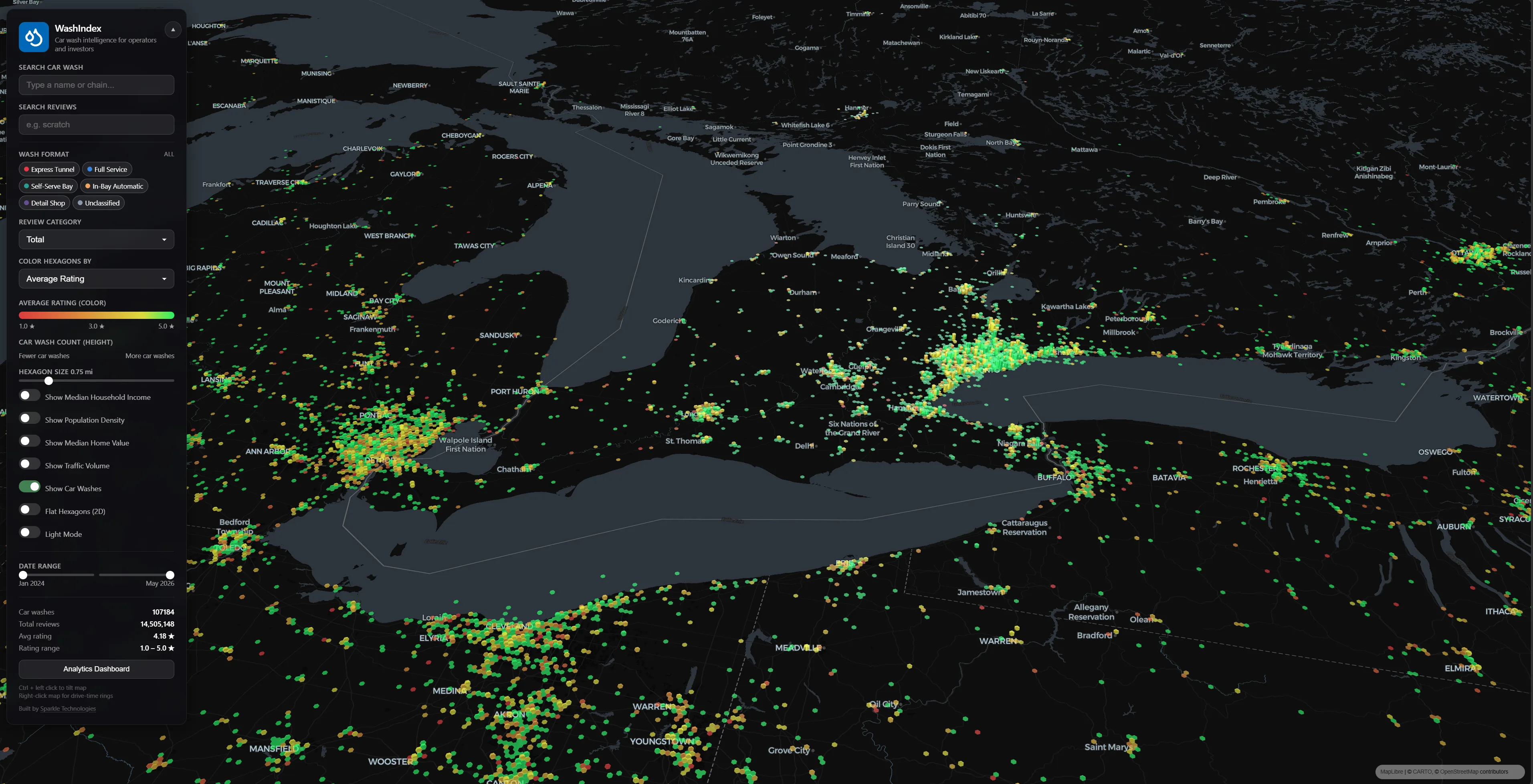
WashIndex now covers Canada. Every car wash from Halifax to Victoria, every province and territory, with the same depth of data we ship for the United States — AI-analyzed reviews, customer-experience scores across the seven pillars, format classification, opportunity scoring, drive-time competitive sets, and pricing in Canadian dollars. This is what changed in v1.2.
Why Canada now
The questions operators and investors are asking on the US side of the border — which markets are saturated, which sites are mispriced, which acquisition targets are over or underperforming their competitive set — are exactly the questions being asked north of the border too. Canadian operators have wanted comparable data for the same reasons. US chains evaluating Canadian expansion have wanted to underwrite trade areas the same way they underwrite Texas or Florida. Lenders financing cross-border roll-ups have wanted one dataset, not two.
Until this release, anyone working on a Canadian deal had to stitch together a Canadian-only view by hand — pulling Google reviews market by market, calling around for pricing, classifying formats from photos. WashIndex now does all of that, the same way it does for every US wash.
What’s covered
Every car wash location across all ten provinces and the territories. Express tunnels, full-service, in-bay automatics, self-serve bays, and detail shops — every format classified the same way it is in the US dataset, so cross-border comparison works without translation. The dominant Canadian chains, the regional operators, and the long tail of independents are all in.
Customer reviews are ingested and scored end-to-end. Every review runs through the same AI extraction pipeline used on the US side, producing scores across the seven customer-experience pillars and the 55 underlying signals. The same per-location ratings, complaint patterns, sentiment trends, and signal volatility metrics show up on every Canadian car wash card.
Pricing, in Canadian dollars
Pricing landed for Canada the same way it landed for the United States in v1.1 — operator websites scraped for the chains that publish their menus, AI calling agent ringing up the long tail. Single-wash prices, package and tier pricing, and unlimited-membership rates are all captured. Values are stored and displayed in Canadian dollars, with currency flagged on every record, so cross-border price comparisons make sense rather than being silently distorted by exchange-rate confusion.
This means a Canadian operator benchmarking their $39.99/mo unlimited against the local competitive set sees a clean, like-for-like comparison — not a US-priced average dragged in from across the dataset. A US chain evaluating Canadian expansion sees what the local market actually charges, in the currency the market actually transacts in.
Why the dual-source approach matters even more in Canada
Canada’s car wash market skews more toward independents and smaller regional chains than the US does. A larger share of locations don’t publish pricing online — many don’t have a marketing-driven website at all. Scraping alone would have produced a heavily skewed dataset that over-represented chains and under-represented the rest of the market.
The AI calling agent closes that gap. It places outbound calls, asks for the standard menu — basic wash, top wash, package tiers, unlimited membership rate — transcribes the conversation, and writes the captured prices back into the structured per-location record. The same agent we use for US long-tail coverage now runs against the Canadian long tail, and the result is pricing depth in markets where pricing has never been systematically collected.
What you can do with it
The cross-border use cases are the obvious ones, and the most-requested:
- Canadian acquisition diligence: is this target priced in line with its Canadian competitive set, above market, or below? How does its customer-experience profile compare to comparable-format competitors within drive-time?
- US-to-Canada expansion underwriting: for a US chain considering a Canadian market entry, what does the trade area actually support — on pricing, on competitive density, on customer-experience expectations? Where are the gaps a US format could fill, and where is the market already saturated?
- Canada-to-US benchmarking: for a Canadian operator, how does our chain’s customer-experience profile compare to comparable US chains? Where are we ahead, where are we behind, and what do US chains charge for the equivalent service tier?
- Cross-border portfolio monitoring: for groups operating on both sides of the border, one platform — not two — tracking ratings, pricing, format mix, and competitive density across the full portfolio.
- Lender and PE diligence on cross-border roll-ups: consistent methodology applied to every location in the portfolio, in the local currency, with the same competitive-set definitions.
What stays the same
The methodology is identical to the US side. Same review-extraction pipeline. Same seven customer-experience pillars. Same format taxonomy. Same opportunity-score components. Same monthly refresh cadence — operator-website prices re-pulled every refresh, calling agent re-running against the long tail on a slower rotation. Nothing about Canadian data is treated as a second-class dataset — it’s the same depth, the same structure, the same standards.
This is the simplest way to put it: Canada now works exactly like the US works on WashIndex.
Try it
Open the platform at platform.washindex.com and pan the map north — every wash in Canada is there, with the same level of detail you’re already used to in the United States. If you want a guided walkthrough of a specific Canadian market or a deeper engagement on a cross-border portfolio, send us an email at contact@washindex.com.